· VPX Team
How to run your own mock trading game
If you are aiming for a trading seat at a quant firm, you have probably played a mock trading game. Someone makes a market on a number nobody knows yet, everyone trades, information leaks out round by round, and the contract settles at the end. Firms use them in interviews and campus events because they show in ten minutes what a CV cannot.
A VPX private market runs one for you: a real order book, positions, a running P&L and a settle button, all on play money. No whiteboard, no spreadsheet, no arguing about who owns what.
The screenshots below use a classic, "What do the five cards in the envelope add up to?", with Priya hosting and Arjun, Mei and Tom trading. It assumes you already know how an order book works.
In this guide
The basics in 30 seconds
A mock trading game is a private market with the Future settlement type. Four things differ from a yes or no market:
- One contract, priced in points. No YES and NO shares. Buy to go long, sell to go short, and your position is a single signed number.
- A multiplier. Each point is worth a fixed amount per contract. At $10, being long 5 while the price moves 2 points is $100.
- Price bounds. The lowest and highest the number can be. They clamp the settlement and cap the loss on a contract.
- Settlement at a value. At the end the host types the true number, and longs and shorts are paid against it.
Futures always run in simple mode, a one-contract panel with your position and buying power on top. Turn on quick commands and players type b 10 34 to bid 10 at 34, or s 5 36 to offer 5 at 36. It is all play money, and the standings are the score.
Step 1: Set up the contract
Sign in, open the VPX home page, and press the plus in the Private Markets section. Fill in the question and rules, then pick Future under "What settles this market?".
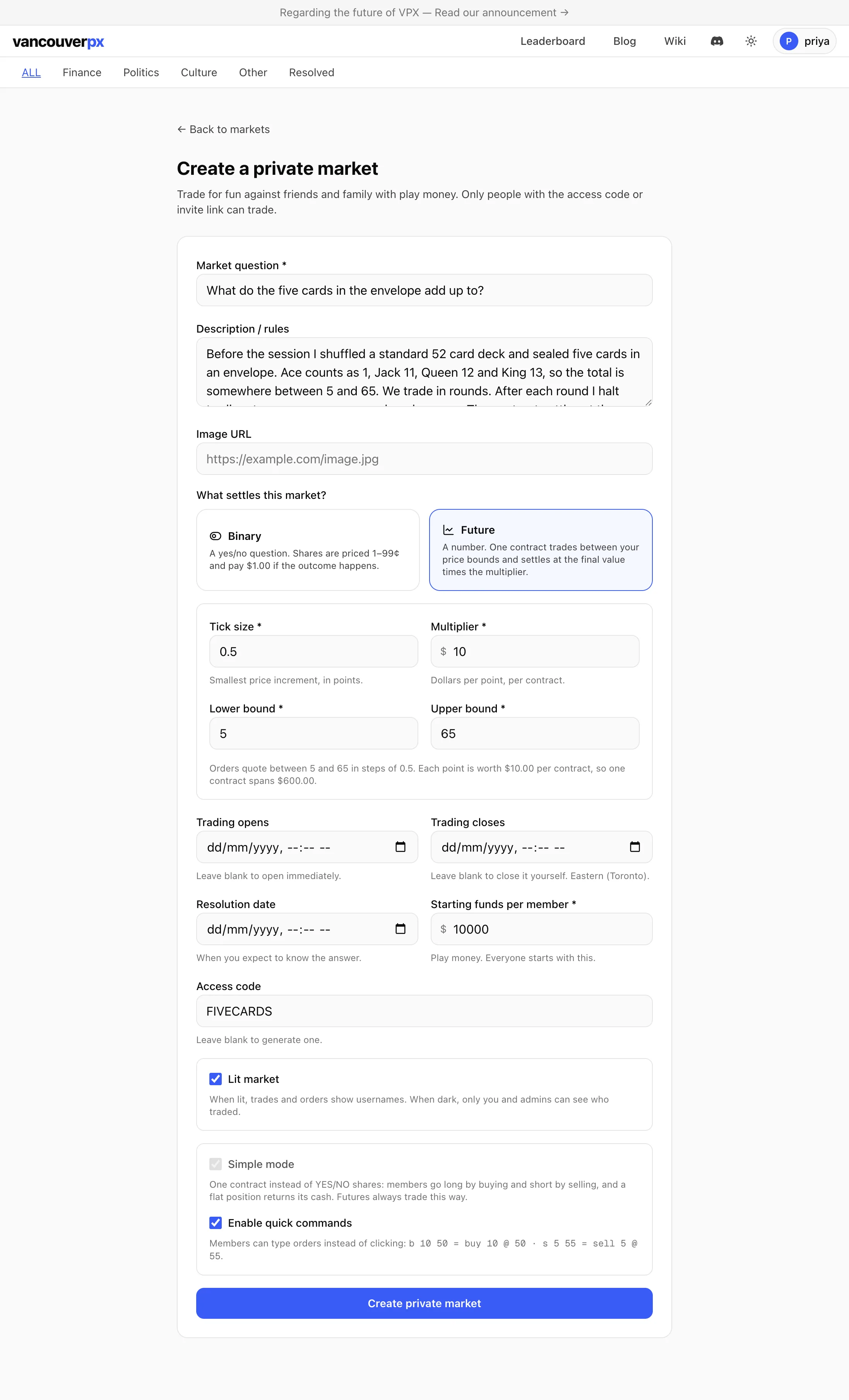
The futures fields are the game:
- Tick size. The smallest price step. We used 0.5.
- Multiplier. Dollars per point per contract. Ours is $10, so a contract bought at 34 and settled at 42 pays $80.
- Lower and upper bound. The range the answer can land in. Five cards, an ace as 1 up to a king as 13, add up to somewhere between 5 and 65.
The rest is the usual setup: $10,000 in starting funds, access code FIVECARDS, market left lit. Simple mode is locked on for futures, and we ticked Enable quick commands. In the rules box, write how the number is decided and how the rounds work.
Press Create private market for the invite link and access code.
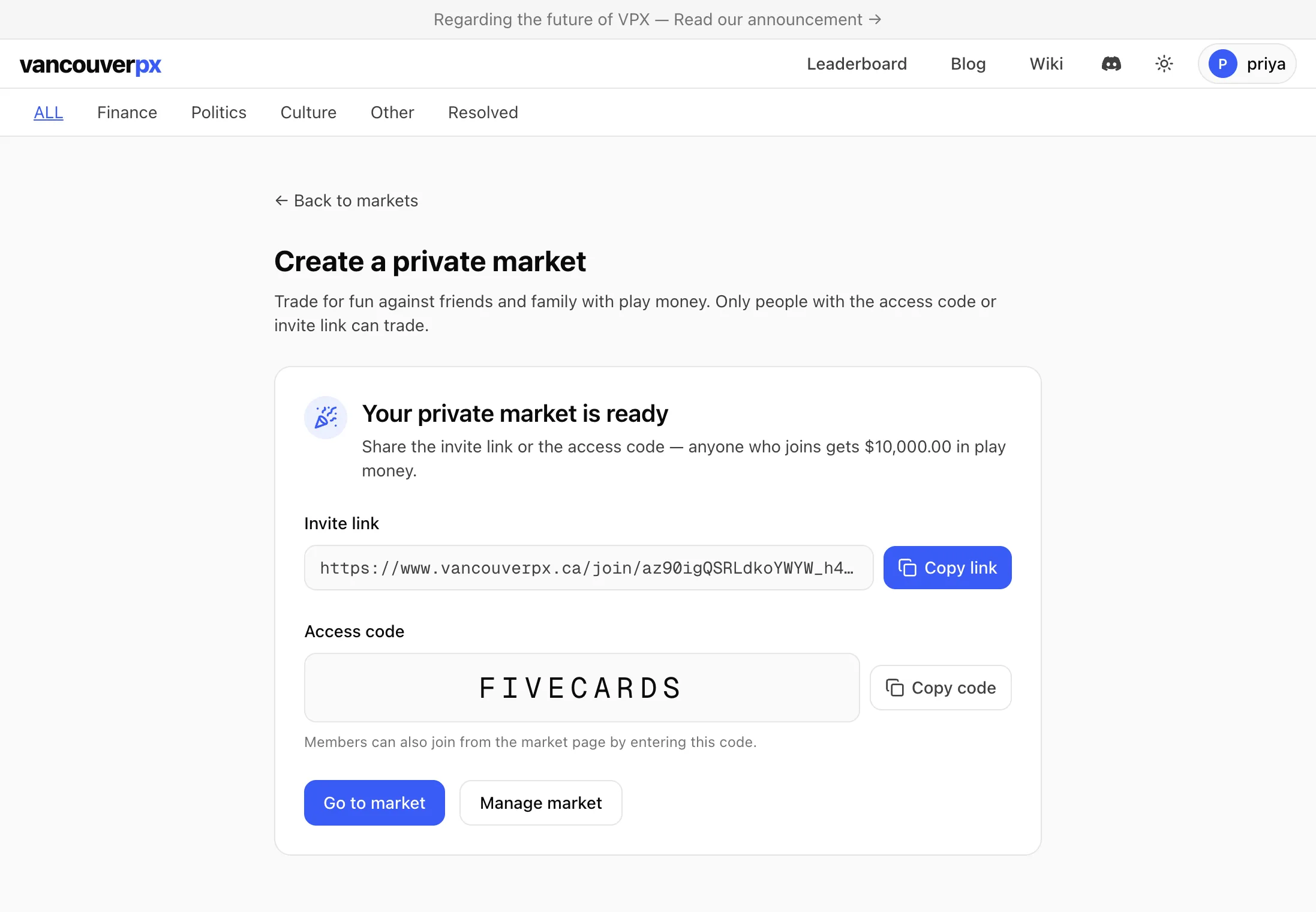
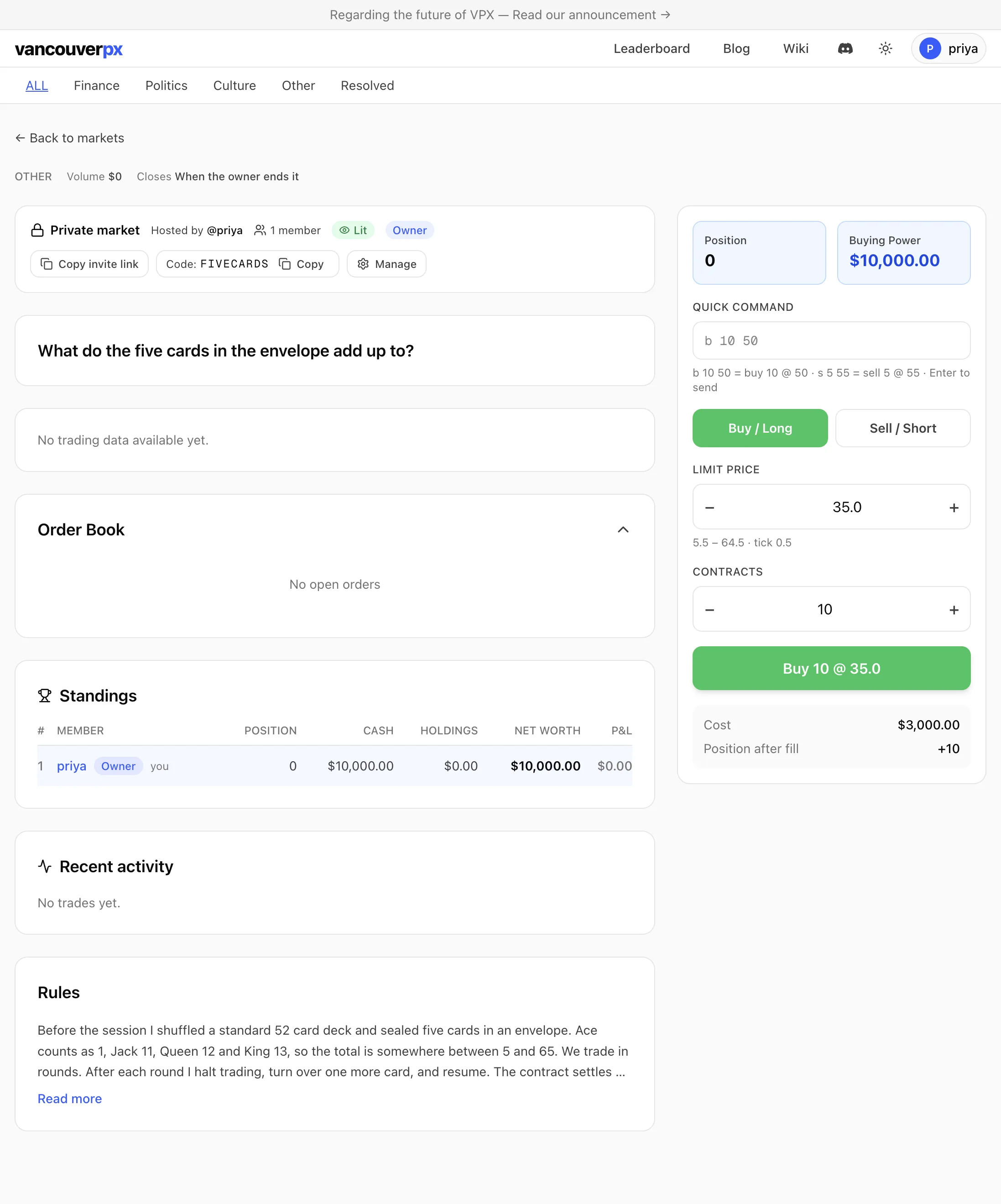
Go to market opens the empty market: the host banner, the question, a blank order book, the standings, and the trade panel in simple mode. The price starts at the middle of the bounds.
Step 2: Get your traders in
- Share the invite link. Anyone who opens it joins with the starting funds, after a quick sign up if they are new. For a room, put a QR code of the link on the projector.
- Or share the access code. Players who already have an account can open the market and type it. Our private markets guide covers both routes in detail.
- Stay flat as the host. Running the rounds is easier than trading at the same time. For a house market maker, add a second account as a member.
Step 3: Trade with quick commands
Simple mode shows your Position and Buying Power, a Quick command box, Buy and Sell buttons, and the price and quantity below. The buttons and the commands do the same thing.
No cards are showing, so fair value is about 35. Arjun leans long and types b 10 34.

Buying power drops from $10,000 to $7,100. A long at 34 risks the distance down to the lower bound: 34 down to 5, times the $10 multiplier, is $290 a contract. A short posts the distance up to the upper bound instead. That is what the bounds are for. They set the collateral.
Mei offers 10 at 36 with s 10 36, Tom bids 5 at 35, and there is a market.
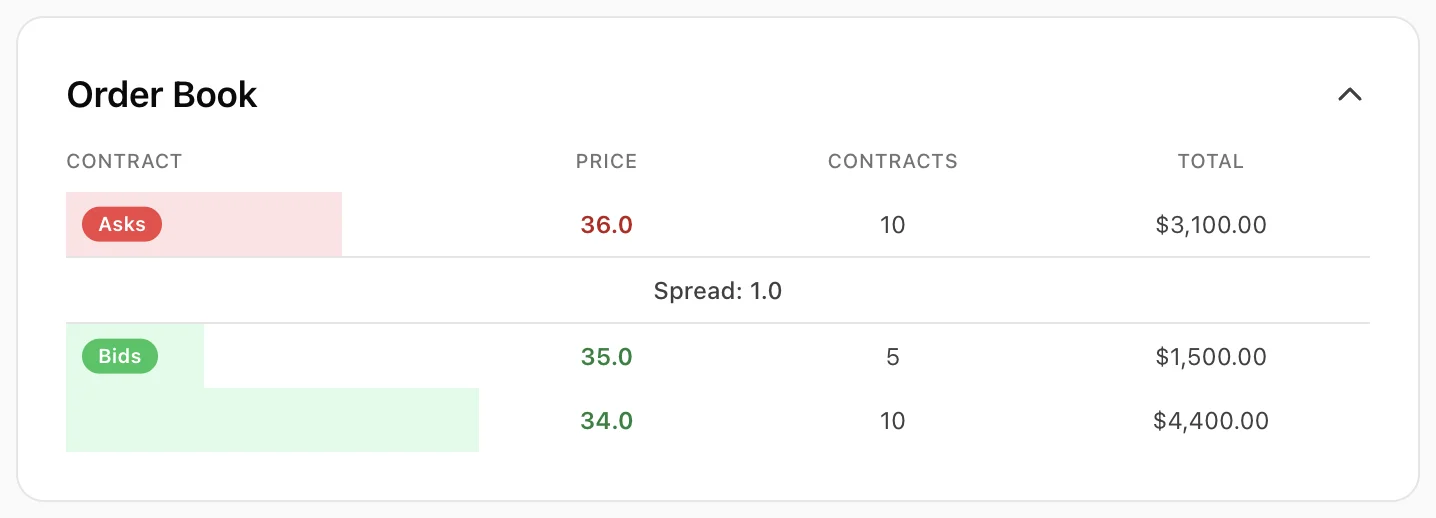
Tom lifts 5 of Mei's offer with b 5 36. The trade prints, the last price is 36, and the standings pick up the new positions.
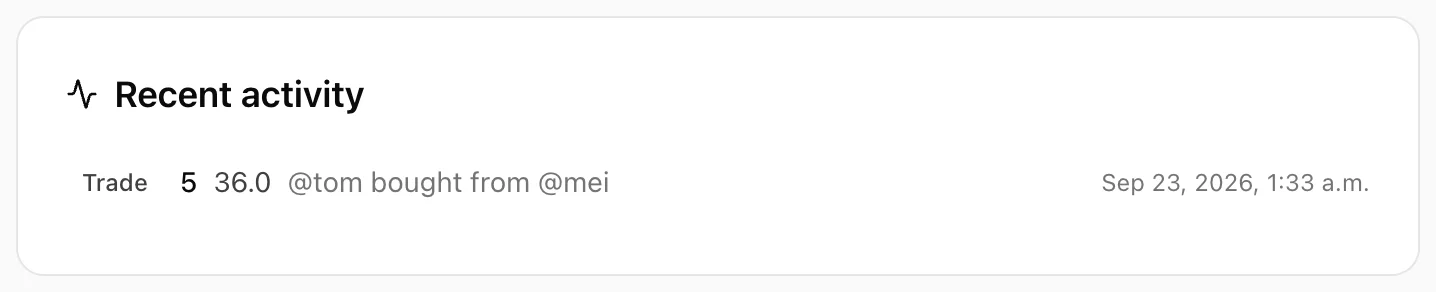
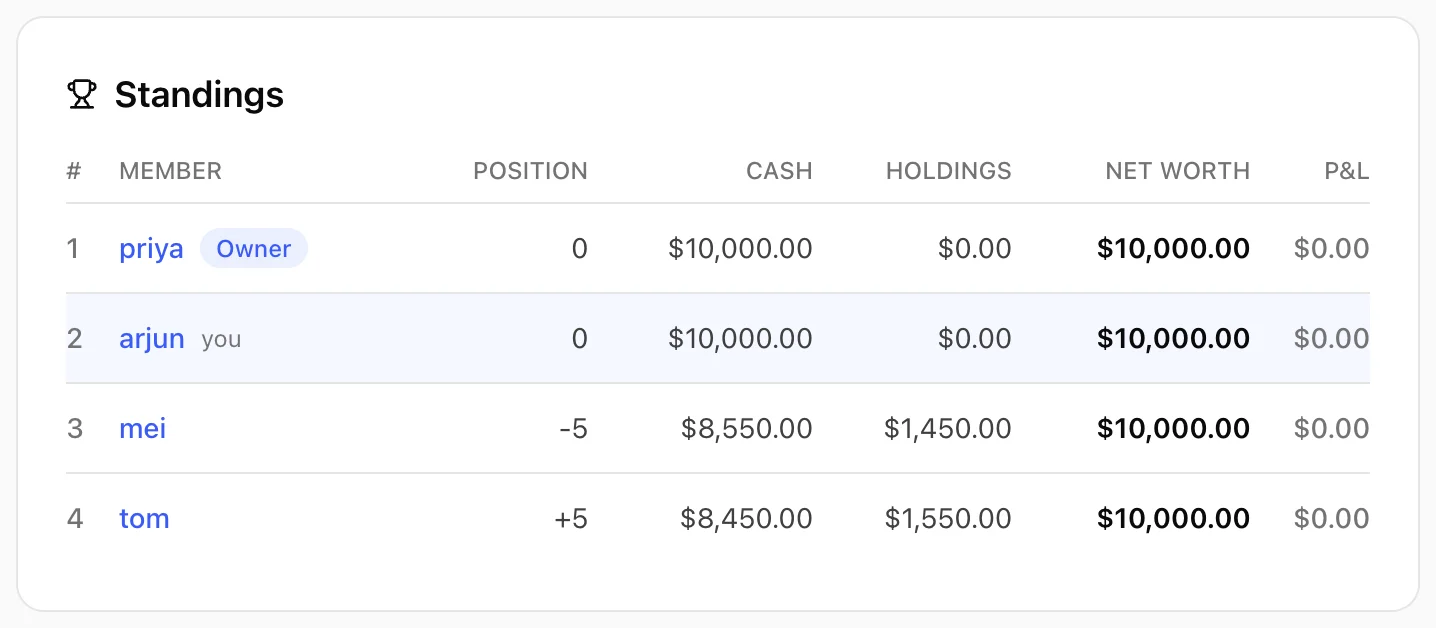
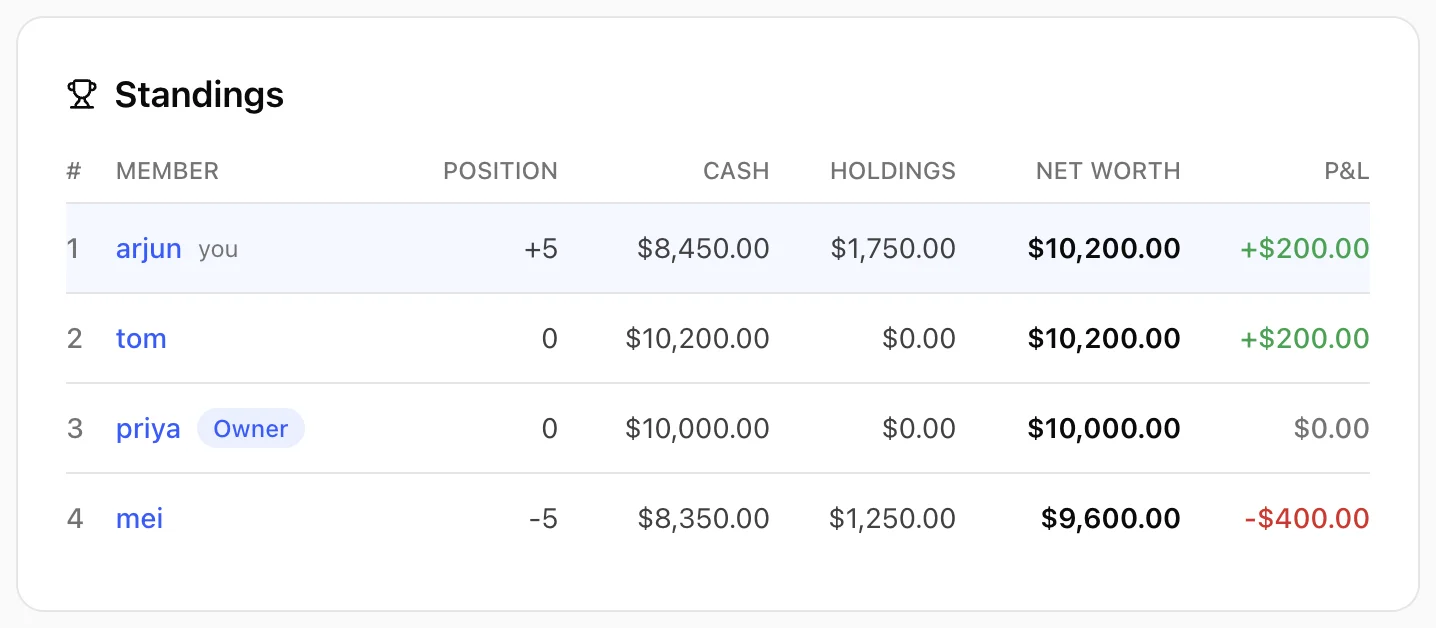
Tom is long 5 and Mei is short 5, both still at $10,000 net worth. Standings mark positions at the last trade until settlement. Unfilled orders rest under My Orders to cancel. The order book wiki page has the matching rules.
Step 4: Run the rounds
Each round brings new information. The Trading tab on the Manage page runs it. Open it from Manage in the market banner.

- Halt trading is the round boundary. New orders are blocked, the book stays exactly as it is, and players see a paused notice.
- Cancel all open orders clears stale quotes so nobody gets picked off on the reveal.
- Close trading stops trading until you reopen it, for a longer break.
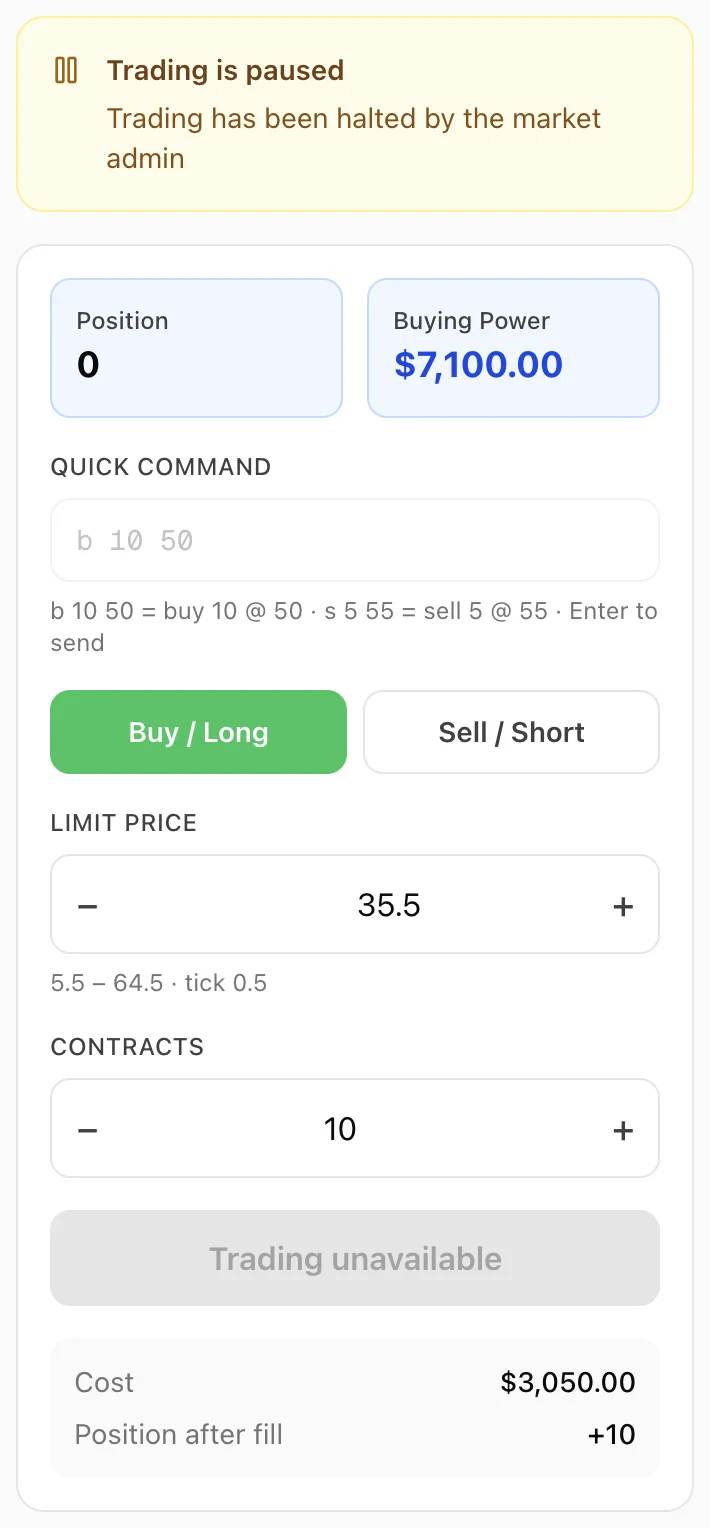
Halt, reveal, resume. Priya turns over the queen of hearts, worth 12. With a 12 down, fair value moves toward 40: Arjun lifts the rest of Mei's offer, Tom sells his 5 to Mei at 40 to bank a profit, and the quotes follow.
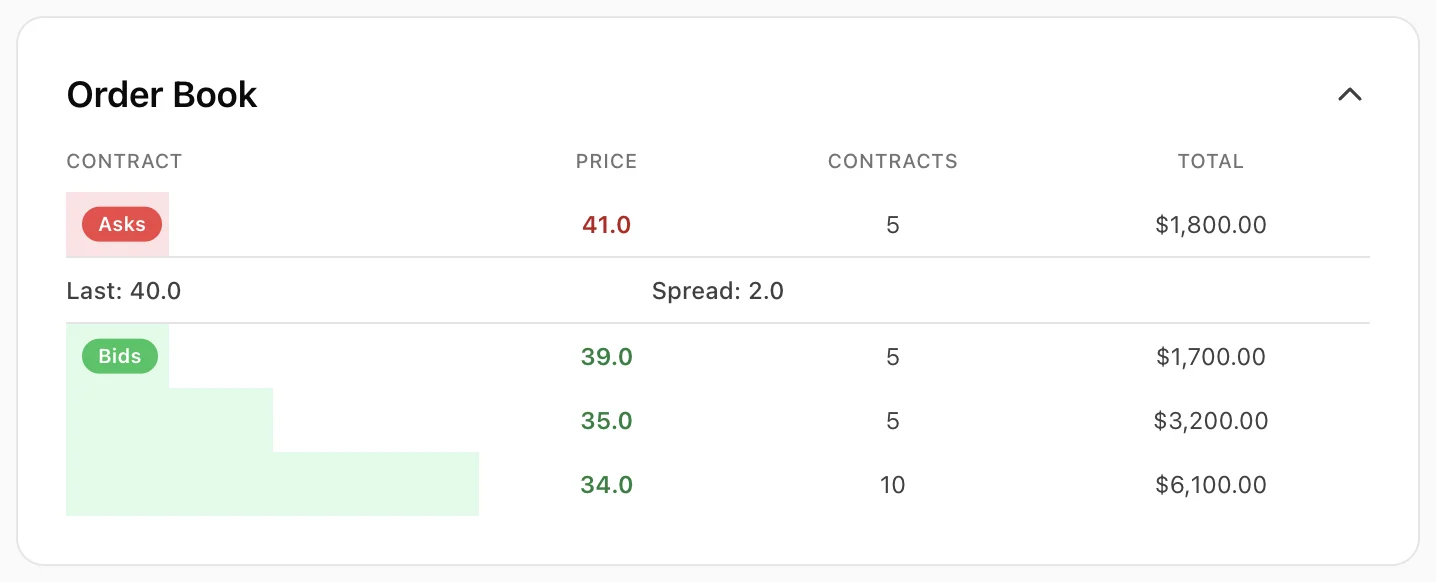
Standings mark to the last trade, so the reveal lands in the P&L column at once. Arjun is up $200 on his open long, Tom has banked $200, and Mei is down $400 on her short. Nothing is final until settlement.
Repeat for every card. Halt, reveal, resume.
Step 5: Settle and read the standings
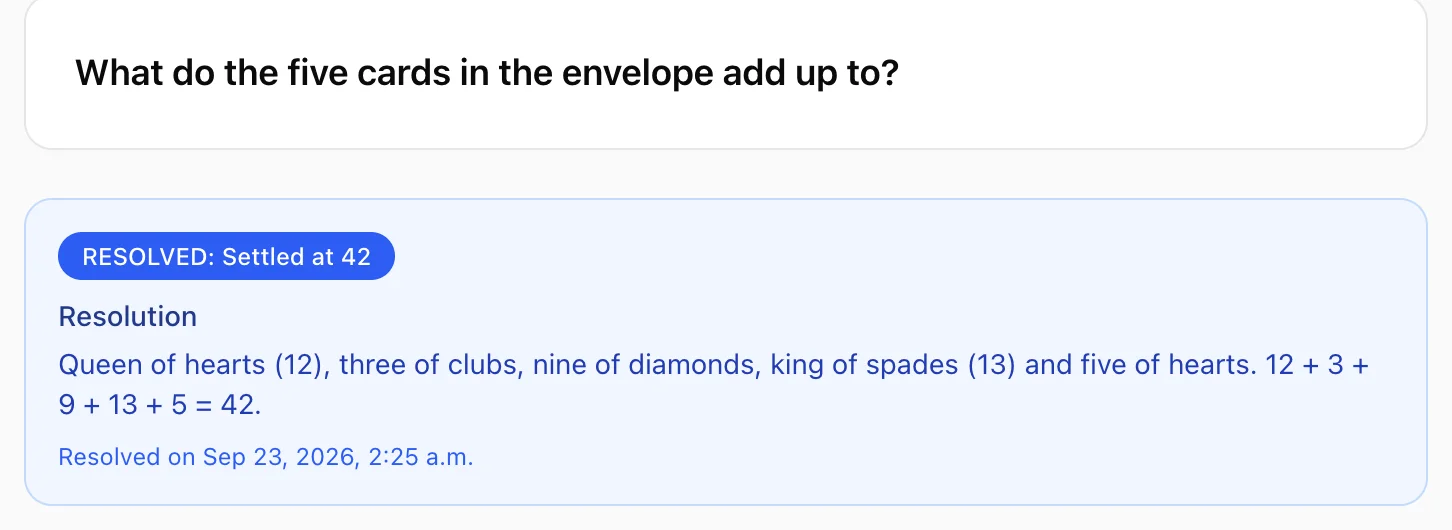
The last card turns over and the five add up to 42. On the Trading tab, press Settle market, enter the value, and add a short note.

Settling cannot be undone, so check the number twice. Resting orders are cancelled and their locked cash returned, so Arjun's unfilled 34 bid comes back. The market page shows the result and the note.
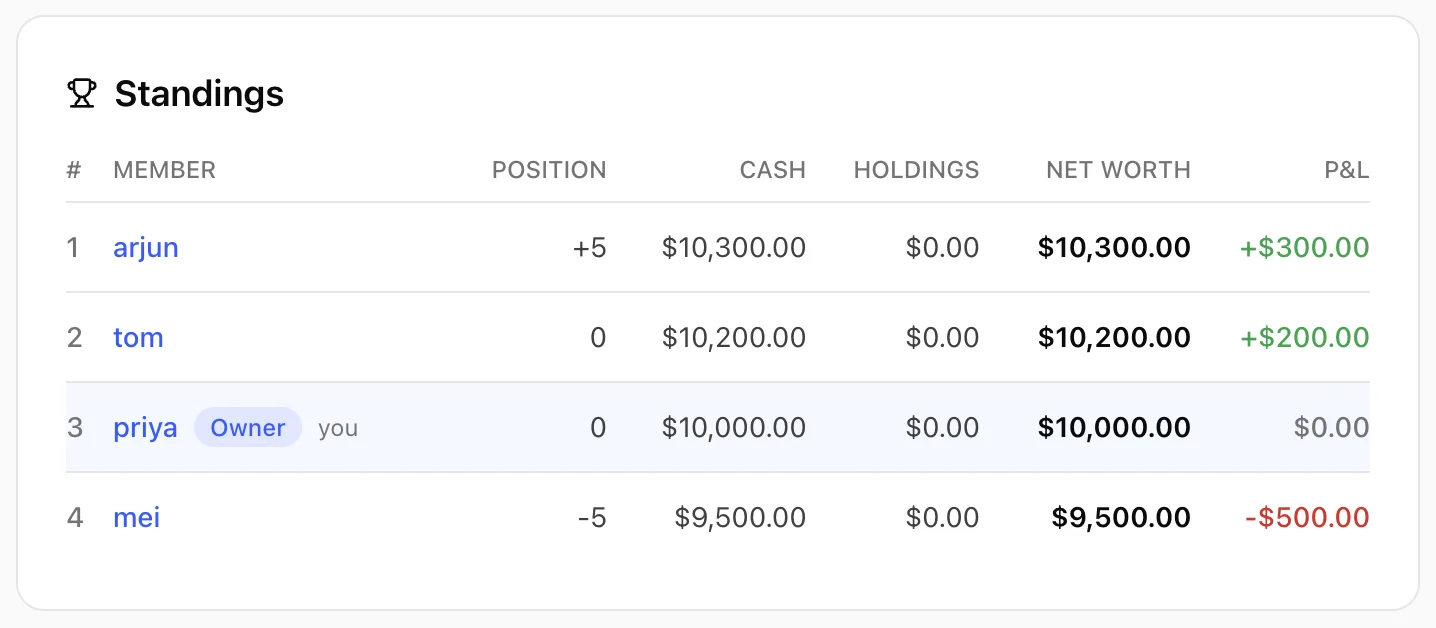
Where the money went, at $10 a point:
- Arjun bought 5 at 36 and held to 42: six points, times $10, times 5, is up $300.
- Tom bought 5 at 36 and sold at 40: four points, times $10, times 5, is up $200, banked before the last card.
- Mei sold 10 at 36, covered 5 at 40 for a $200 loss, and carried 5 to settlement for a $300 loss, down $500.
The gains equal the loss. Play money only moves between players, the same accounting as any futures pit.
Game ideas
Any number you can reveal in stages makes a game:
- Sum of five cards. The one above. Reveal a card per round.
- Dice in a cup. Ten dice, revealed a few at a time, settle on the sum. Bounds of 10 to 60.
- The jar. Coins or sweets in a jar. Give a clue per round: the weight, the height of the pile, a photo from above.
- Trivia futures. Words in a Wikipedia article, minutes in a film, steps between two buildings. The answer holder reveals a bracket each round.
- Two markets at once. Run a related second market, like the highest single card, and watch who spots the link.
Write the reveal schedule and the settlement rule into the description before anyone trades, and pick bounds the answer cannot escape.
Common questions
Is this real money? No. Private markets use play money only. Nothing is deposited or paid out.
How big should the multiplier be? Big enough that a few points of edge shows in the standings, small enough that one contract is a fraction of the starting funds. Aim for a player being able to run ten to twenty contracts before hitting the buying power wall.
What if the answer lands outside the bounds? It is clamped to the bounds, so a contract never pays more than its full span. Set the bounds from the rules and this will not come up.
Buttons instead of quick commands? Fine. Quick commands are an extra you can switch off from the create form or the Settings tab.
Several rounds in one market? That is the normal way. Halt, reveal, resume, and cancel all orders while halted if you want each round to start clean.
Can traders see who they trade against? In a lit market, yes. Switch to dark in Settings to hide names on trades. Standings are named either way.
Does the host have to trade? No. Sit out and run the rounds, or add a second account as a house market maker.
That is the whole game: set the contract, get people in, halt and reveal, settle. The first one takes about ten minutes, the second takes two. To go deeper on matching, read the order book wiki page.